


We all love the moment we reveal a stunning new floor. We marvel at the deep grain of Luxury Vinyl Tile (LVT) or the rich polish of hardwood, like the grey LVT installation we recently highlighted. But before that final plank is locked into place, an invisible, crucial process must happen. The secret to a durable, smooth, and quiet floor isn't just the flooring material you choose—it's the surface underneath.
Welcome to our guide on the absolute importance of subfloor preparation. Skipping this step is the fastest way to turn a dream floor into a costly nightmare.
Part 1: What Happens When You Ignore the Subfloor?
Your finished flooring is only as good as the foundation it rests on. The subfloor (usually concrete or plywood) provides the structural support. If that surface is uneven, damaged, or wet, your new floor will telegraph those problems.
If you don't invest in proper preparation, you risk:
"Telegraphing" Imperfections: Dips, bumps, or seams in the subfloor will show through resilient flooring like LVT. You'll see the defects.
Noisy, Bouncy Floors: Uneven surfaces create voids. Walking across gaps causes the planks to flex and squeak, ruining that quiet, comfortable feeling.
Structural Failure: For interlocking floors, unevenness puts immense stress on the joint mechanisms, potentially causing them to break and the planks to separate.
Moisture Damage: A damp subfloor trapped beneath waterproof LVT can lead to mold growth and adhesive failure.
Part 2: Seeing the Problem in Action
Let’s look at a common scenario in many modern homes and basements: the uneven concrete slab.
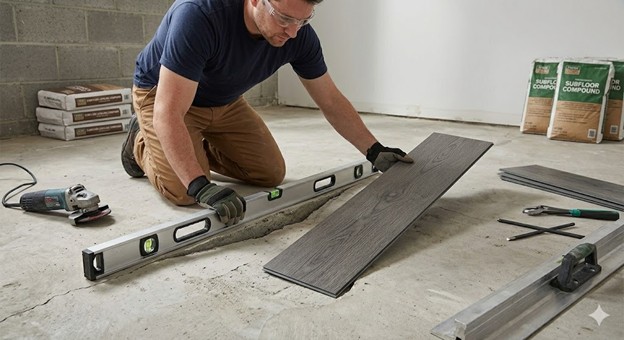
In this technical shot, we move into a utility room or workshop setting. The environment is practical, brightly lit, and perfect for illustrating the initial challenge.
The Invisible Dip: A Major Installation Hurdle
Analyze the Challenges Highlighted in This Scene:
The Dip Detection: A professional installer, equipped with safety gear, is kneeling. They have laid a 3-foot level on the concrete, and a very clear gap is visible beneath the level. This is a significant low point that must be addressed.
Material Failing to Lay Flat: To demonstrate the problem, the installer is holding a single dark grey wood-grain LVT plank (the identical high-quality material used in our previous finished living room example). Notice how the plank gaps and rocks when attempting to span the dip. If installed here, the floor would flex, feel unstable, and eventually fail.
Tools of the Trade: An angle grinder and screeding tools are ready—this isn't just a inspection, it's the start of the preparation work. Stacks of subfloor leveling compound are visible in the background against the cinder block wall, ready for the solution.
Part 3: The Resolution—The Foundation of a Perfect Floor
After the installer identifies the problem, the preparation process moves into a technical phase. In this case, that means addressing the concrete dip.
The Art of Leveling and The Flawless Finish
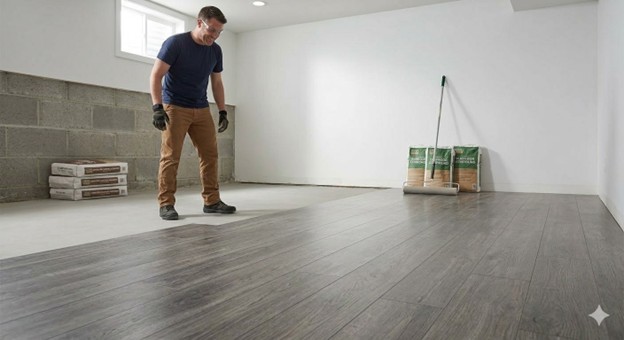
Here is the same basement workshop setting, now transformed by the solution:
Observe the Differences in this Resolved Scene:
The Level Foundation: The ground is now smooth, level, and clean. The prominent low point is gone, seamlessly filled with the self-leveling compound. This perfect foundation ensures the new floor will have zero movement or bounce.
Seamless Installation: We see the technician from the previous shot, smiling as they look down. A section of the grey wood-grain LVT—the exact material used in image_0.png and image_1.png—is perfectly installed. Because the subfloor is level, the planks are locked together seamlessly, creating a strong, stable, and flat surface. The transition from the bare (now smooth) concrete to the installed LVT is visible.
Proof of Preparation: The bags of leveling compound and the roller used for application, seen in image 4, are now empty and set aside, confirming the hard work of prep that made this beautiful finish possible. The depth of field highlights the smooth flatness and the clean lines of the finished flooring, ready for use.
Conclusion: Ready to Start Your Own Transformation?
The difference between a "good-enough" floor and a truly "flawless" floor is almost always found in the hours of meticulous preparation before the first plank is laid. Your finished flooring is the hero, but the subfloor is the foundation that makes it a hero.
At Buffaloe Floors, we never skip prep. We understand that your investment deserves a surface that is not only visually stunning but also durable, quiet, and built to last.
If you are thinking about upgrading your home with LVT or any other material, we encourage you to contact us. We’ll perform a full subfloor assessment and ensure your project starts with the strongest possible foundation for success.


